Car Breakdown on a UAE Highway: What to Do, Step by Step
Car broken down on a UAE highway? A step-by-step guide to stopping safely, where to wait, when to call 999 and how to get the car recovered on a flatbed.
- Written by
- FixAnyCars Team
- Published
- Updated
- Reading time
- 6 min
In this guide
- What should you do the moment something goes wrong?
- Should you stay in the car or get out?
- Do you need a warning triangle?
- When should you call 999?
- Should you try to fix the car yourself?
- How do you get the car off the highway?
- What happens after the car is recovered?
- How can you lower the chance of a breakdown?
- Has your car broken down right now?
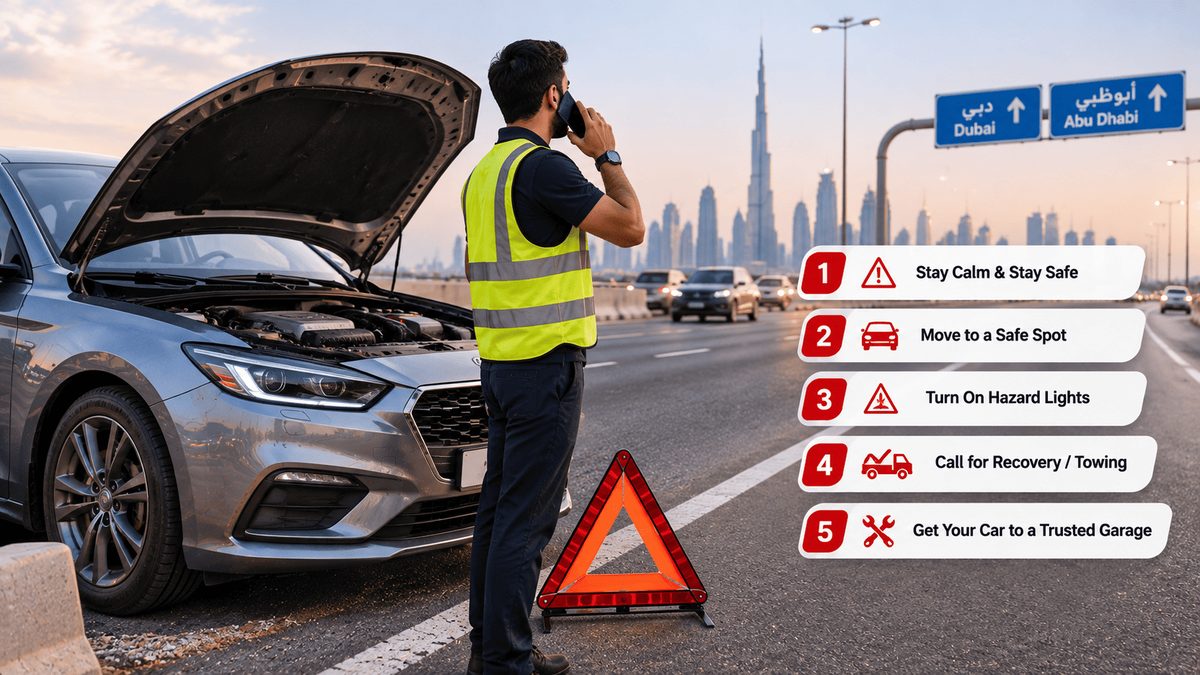
If your car breaks down on a UAE highway, get it as far out of the traffic as you can, switch on your hazard lights, and get everyone out on the side away from traffic. Wait behind the barrier or well away from the road, not inside the car, even in the heat. Call 999 if you are stuck in a live lane, anyone is hurt or you feel in danger, then arrange recovery on a flatbed.
What should you do the moment something goes wrong?
When you feel a loss of power, see a red warning light, smell burning or hear a loud noise:
- Indicate and move towards the hard shoulder, ideally the one on the right, away from the fast lane.
- Switch on your hazard lights straight away.
- Use the car's remaining momentum to get fully off the road. Do not stop in a lane if you can coast to the shoulder.
- Avoid stopping just over a hill or just around a curve, where drivers behind cannot see you in time.
- Stop as far from the traffic as possible, turn the wheels away from the road and apply the handbrake.
The RTA's driver handbook says to pull right out of the traffic flow if possible, and if you cannot, to stop where other drivers can easily see you, with hazard lights on. You can read it in the RTA Light Motor Vehicle Handbook.
Should you stay in the car or get out?
On a highway, get out. The RTA handbook is clear that you and your passengers should not sit in the vehicle while waiting for help on high-speed roads, even when it is very hot, because a stationary car can be hit by traffic that does not see it in time.
- Leave by the doors away from the traffic. Check mirrors before opening any door.
- Stand as far from the traffic as possible, behind a crash barrier if there is one. Do not stand in front of the car or between the car and the traffic.
- Take water, phones and anything you need, then close the doors.
- Never leave children or pets in a parked car. A closed car in the UAE sun heats up very quickly.
- In summer, find shade if there is any safe place away from the road, and keep drinking water.
Do you need a warning triangle?
The RTA handbook says that once the vehicle is in a safe position, a warning triangle should be placed 50 metres behind the car, in the direction traffic is coming from. Where there is no street lighting or it is hard to see, it says you must use a reflective triangle or lights to warn other drivers. It also suggests lifting the bonnet or boot lid to show other drivers that you are in trouble.
Only walk back with a triangle if you can do it safely, well away from moving traffic. Your own safety comes first.
When should you call 999?
Call the police on 999 if:
- The car is stopped in a live lane and cannot be moved
- Anyone is injured (998 is the ambulance number)
- There was a collision
- There is smoke or fire (997 is the fire service, Civil Defence)
- You feel unsafe
The UAE government's guide to handling emergencies lists these numbers. For a minor accident where nobody is hurt, it says you can move your car to the shoulder lane so it does not block traffic, and wait for the police at least 15 metres away from your car.
Should you try to fix the car yourself?
On a highway shoulder, no. Changing a tyre or working under the bonnet with traffic passing close by is dangerous. A breakdown on a quiet side road is a different situation, but on a highway, wait for help.
A few things are fine to check from a safe position:
- Is the temperature gauge in the red? Then do not restart the engine.
- Is a tyre flat or damaged?
- Is there fuel?
Do not open the radiator cap on a hot engine; coolant is under pressure and can scald.
How do you get the car off the highway?
Once everyone is safe, arrange recovery:
- Check your insurance. Some policies include roadside assistance; the number is usually on your policy documents or card.
- Share your exact location. A location pin from your phone is the most reliable way, plus the direction you were driving and the nearest exit or landmark.
- Describe the car and the problem: make, model, automatic or manual, whether the wheels and steering turn.
- Insist on a flatbed for automatics, four-wheel drives and hybrids. Towing with the driven wheels on the ground can damage the gearbox, because an automatic gets no oil pressure with the engine off. A flatbed lifts the car fully off the road.
- Agree the price before the truck is sent.
Our car recovery and towing service uses flatbeds. For a car that will not start or move, see breakdown recovery and towing. After a collision, see accident car recovery. The recovery fee is agreed before the truck is sent and is listed again on your written quote.
We reply from 9 AM to 10 PM, usually within 30 minutes. If you are in a dangerous position, or it is outside those hours, call 999 first.
What happens after the car is recovered?
We take the car to our workshop, find the fault and send you a written quote before any repair starts. The quote lists the parts and lets you choose OEM, aftermarket or used, each with its price. Diagnosis is free if you go ahead with the repair with us; if you decide not to repair, it is charged at the amount on your quote. When the work is done, we can deliver the car back to you.
How can you lower the chance of a breakdown?
Heat, tyres, batteries and cooling systems are worth checking before a long drive.
- Check tyre pressures and condition, including the spare. Heat and high speed are hard on tyres.
- Have the battery tested before summer and after it, and replace it when it is weak. A battery health check can be done at your location.
- Watch the temperature gauge and keep the coolant topped up. See engine overheating repair if it runs hot.
- Keep water in the car, a charged phone and a warning triangle.
- Do not ignore warning lights. A check engine light or a gearbox warning is easier to fix before it strands you.
Has your car broken down right now?
Get yourself and your passengers safe first. Then send us your location pin, the make and model and what happened, and we will agree the recovery fee before sending a flatbed. Book online.