How to Spot Accident Damage on a Used Car: UAE Guide
How to tell if a used car has been in an accident: paint, panel gaps, bolts, glass dates, airbags and chassis signs to check before buying in the UAE.
- Written by
- FixAnyCars Team
- Published
- Updated
- Reading time
- 4 min
In this guide
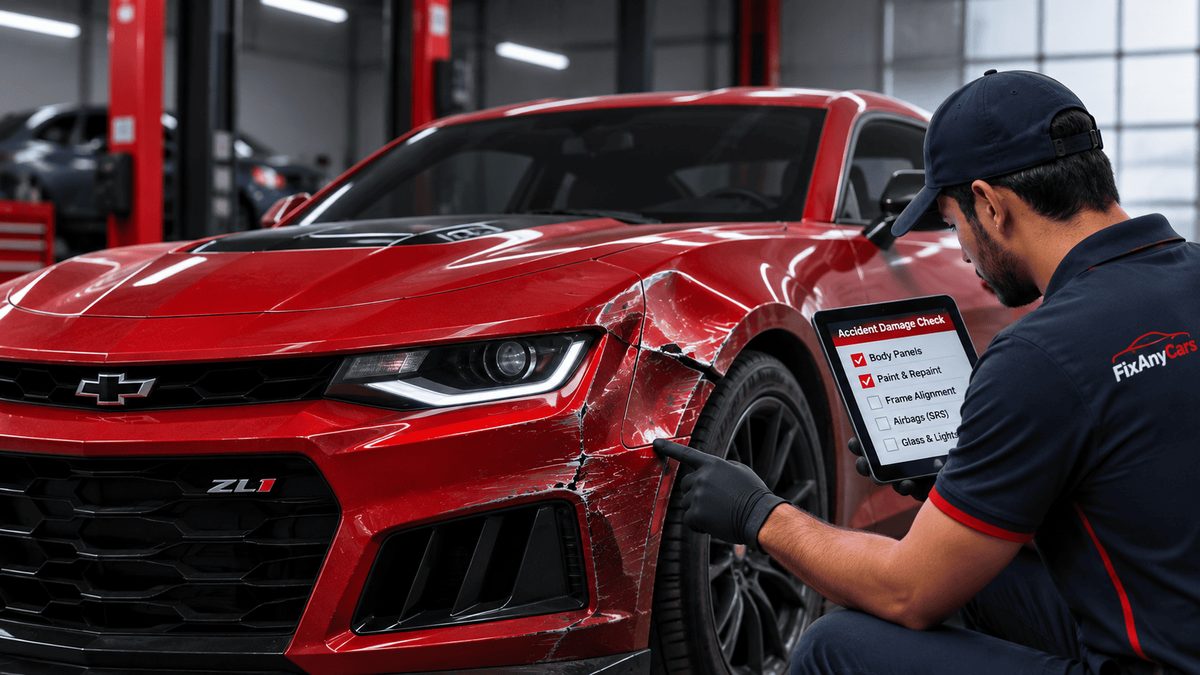
Many used cars in the UAE have had some accident repair. A small, well-done repair is not a problem. A badly repaired car, or one that had structural damage, can be unsafe and hard to sell later. This guide shows what to look for yourself, and when to get a professional pre-purchase inspection.
Why accident history matters
- Safety. A car with a repaired chassis or crumple zone may not protect you the same way in a second crash.
- Value. Cars with major repairs sell for less, and you should pay less for them.
- Future faults. Accident damage can lead to alignment problems, water leaks, rattles and electrical faults months later.
Check the paint
Look along each side of the car in daylight, from the front and the back corners.
- Colour differences between panels, especially between a door and the wing next to it.
- Texture. Factory paint is smooth with a light "orange peel" texture. Resprayed panels can look flatter, glossier or rougher.
- Overspray on rubber seals, window trims, badges or under the bonnet edge.
- Dust or runs in the paint, which factory paint does not have.
A professional uses a paint thickness gauge, which shows refinished panels even when the colour match is perfect.
Check the panel gaps
Gaps between the bonnet and wings, between the doors and around the boot lid should be even all the way along and the same on both sides of the car. A gap that is wide at one end and tight at the other, or different from the other side, suggests a panel was removed, replaced or the car was pulled straight.
Check the bolts and fasteners
Open the bonnet and the doors. The bolts that hold the wings, bonnet hinges and doors are painted at the factory. If the paint on the bolt heads is cracked or missing, or there are spanner marks, the panel has been removed. That is not always bad, but ask why.
Check the glass and lights
Each window usually carries a small date code. If one window has a different brand or a much later date than the others, it has been replaced. Headlights that look much newer than the rest of the car, or a mismatched pair, often point to a front-end impact.
Check the airbags and seat belts
- The airbag warning light should come on with the ignition and go out after a few seconds.
- Look at the steering wheel, dashboard and pillars for new covers or trims that do not match the rest of the interior.
- Pull each seat belt fully out. It should retract smoothly and be free of cuts or heat marks.
Look underneath and in the boot
- Lift the boot floor and look at the spare wheel well. Wrinkled metal, fresh sealant or weld marks point to a rear impact.
- Under the front, look at the radiator support and the chassis rails. Crumpled, welded or freshly painted metal points to front damage.
- On 4x4s, check skid plates and suspension arms for bends.
Our chassis inspection covers these points with the car raised where possible.
Imported and auction cars
Cars imported from the US and Canada are sometimes sold at auction after an insurance claim, repaired and then exported. Ask for the chassis number and run a vehicle history report before you buy. Read more in our imported car inspection guide.
Questions to ask the seller
- Has the car ever been in an accident, even a small one?
- Was it repaired at an agency or an independent garage?
- Do you have the repair invoice or the insurance report?
- Was any airbag deployed?
An honest seller will usually answer clearly. If the story changes, or the seller refuses an independent inspection, think carefully.
When to get a professional check
If you are not sure what you are looking at, or the car costs more than a few thousand dirhams, a professional inspection is good value. FixAnyCars checks paint, panels, chassis points, airbags and fault codes at the car's location in Dubai, Sharjah and Ajman, from AED 299, with a written report. Book an inspection.