Engine Overheating in Dubai Traffic: What to Do and Why
Engine overheating in Dubai traffic? What to do when the gauge rises, why cooling fans, leaks and clogged radiators cause it, and how to stop it happening.
- Written by
- FixAnyCars Team
- Published
- Updated
- Reading time
- 6 min
In this guide
- Why do cars overheat in traffic but not on the highway?
- What should you do when the gauge starts rising?
- Is it safe to open the bonnet or the radiator cap?
- What causes overheating in Dubai?
- Can I add water and keep driving?
- How do you stop it happening again?
- What does an overheating repair involve?
- Is your engine overheating right now?
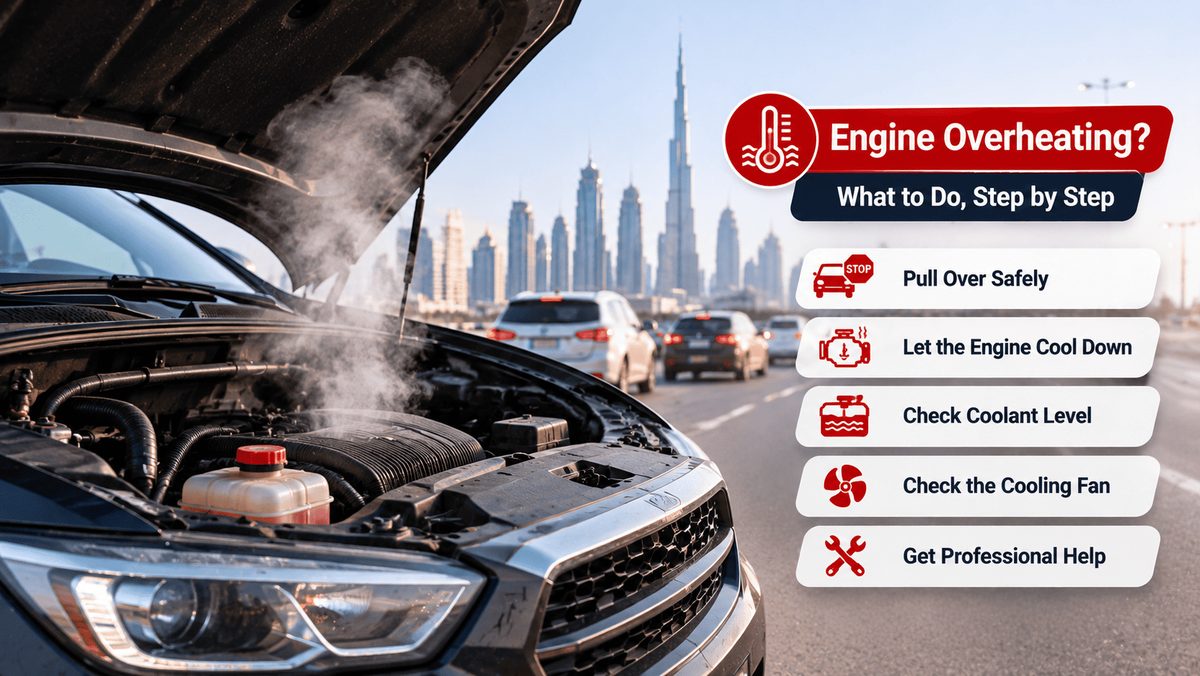
If your engine temperature climbs in traffic, switch off the AC, turn the heater to full hot with the fan on maximum, and pull over safely if the gauge keeps rising. If it reaches the red or you see steam, switch off the engine and do not open the radiator cap. In Dubai, overheating in traffic is most often caused by a cooling fan that has stopped working, low coolant from a leak, or a radiator clogged with dust and sand.
Why do cars overheat in traffic but not on the highway?
At highway speed, air is forced through the radiator at the front of the car and carries heat away. In slow traffic there is almost no natural airflow, so the electric cooling fan has to do all the work. If the fan is weak, fails to switch on, or has a faulty relay or sensor, the engine can stay cool on the highway and overheat in a queue on Sheikh Zayed Road or at a busy junction.
Add Dubai summer heat, the AC working at full load (its condenser sits in front of the radiator and adds heat), and long periods of idling, and any weakness in the cooling system shows up quickly.
What should you do when the gauge starts rising?
- Switch off the AC. It reduces engine load and stops the condenser heating the air going into the radiator.
- Turn the heater to full hot and the fan to maximum. It feels wrong in summer, but the heater is a small radiator. It pulls heat out of the engine and into the cabin. Open the windows.
- Avoid revving the engine and avoid heavy acceleration.
- Leave space to the car in front if you can, so the radiator gets some air.
- If the gauge keeps rising, pull over safely, put on your hazard lights and switch off the engine.
If the gauge goes into the red, a red temperature warning appears, or you see steam from the bonnet, stop as soon as it is safe and switch off. Driving on with an overheating engine can warp the cylinder head and damage the head gasket, which is a far larger repair.
Is it safe to open the bonnet or the radiator cap?
You can open the bonnet once the steam has stopped, to let heat escape, but be careful: parts are very hot.
Never open the radiator cap or the coolant expansion tank cap while the engine is hot. The cooling system is under pressure, and opening it can spray scalding coolant. Wait until the engine has cooled completely, which can take well over half an hour, especially in summer.
What causes overheating in Dubai?
- Cooling fan failure. A burnt-out fan motor, a failed relay, a blown fuse or a faulty temperature sensor. Classic symptom: fine when moving, overheating in traffic.
- Low coolant from a leak. Hoses, the radiator, the water pump or the thermostat housing. Heat makes rubber hoses brittle. Look for green, pink or orange drips, or a sweet smell.
- A clogged radiator. Dust and sand pack the fins from the outside; old coolant can block it from the inside.
- A stuck thermostat. If it does not open, coolant cannot reach the radiator.
- A failing water pump. It circulates the coolant. A leak or whine from the front of the engine is a clue.
- Wrong coolant or plain water. Plain water boils earlier and gives no corrosion protection. It is fine in an emergency, but have the system flushed and refilled with the correct coolant afterwards.
- Head gasket problems. Coolant loss with no visible leak, white smoke from the exhaust, or bubbles in the expansion tank.
Can I add water and keep driving?
Once the engine has cooled fully, topping up with water or coolant to the marked level can get you a short distance to a workshop, if the gauge stays normal. But the coolant did not disappear by itself; something is leaking or failing. If the gauge rises again, stop.
If the coolant level was very low, if there was steam, or if the engine overheated badly, it is safer not to drive. Arrange breakdown recovery on a flatbed; the recovery fee is agreed before the truck is sent.
How do you stop it happening again?
- Check the coolant level regularly, with the engine cold. The tank has minimum and maximum marks.
- Watch the temperature gauge. Know where it normally sits; a needle that sits higher than usual is an early warning.
- Listen for the fan. After a drive in summer, the fan often keeps running for a short time. If you never hear it, have it checked.
- Have the radiator and condenser cleaned if you drive on dusty roads.
- Replace coolant on schedule. Old coolant loses its protection. A coolant flush and replacement starts from AED 129.
- Have hoses and belts checked before summer.
What does an overheating repair involve?
A proper diagnosis checks the coolant level and condition, pressure-tests the system for leaks, tests the fan, relay and sensors, checks the thermostat and water pump, and reads any fault codes. If there is a sign of head gasket damage, that is tested too.
Typical starting points:
- Engine overheating repair from AED 399
- Radiator repair or replacement from AED 599
- Water pump and thermostat replacement from AED 499
Diagnosis is free if you go ahead with the repair with us. If you decide not to repair, the diagnosis is charged at the amount on your quote. Your written quote lists the cause and the parts, and you choose OEM, aftermarket or used, each with its price.
Repairs are done at our workshop. Pickup and delivery is available across Dubai, Sharjah and Ajman. Selected items carry a warranty of 6 months or 10,000 km, whichever comes first, and your quote shows which items are covered.
Is your engine overheating right now?
Stop safely, switch off and let it cool. Do not open the radiator cap. Then tell us the make and model, what the gauge did and whether you saw steam or a leak. We reply from 9 AM to 10 PM, usually within 30 minutes. See our engine repair service or book online.